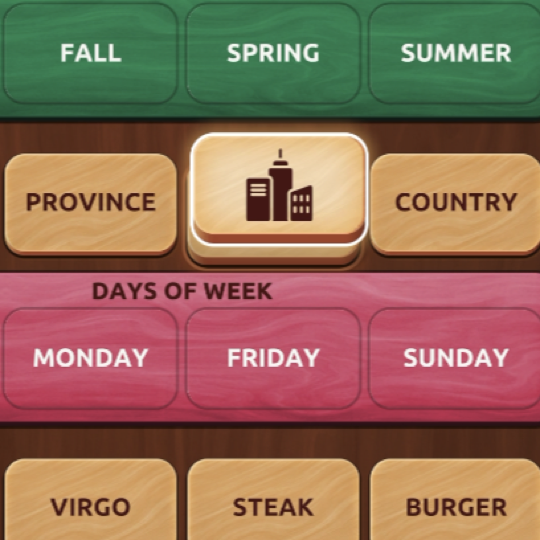
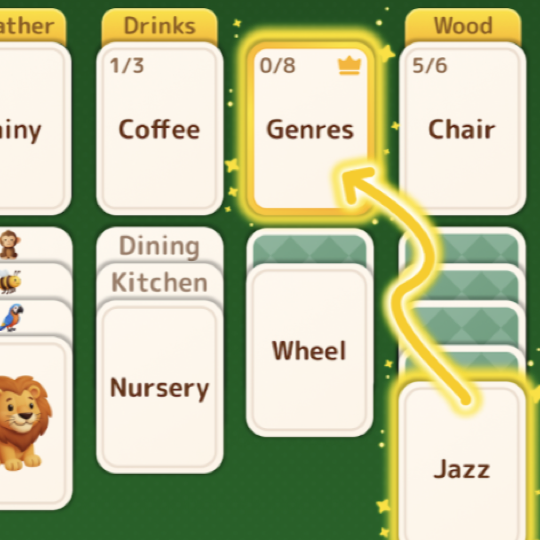
Word association games are having their moment. Connections proved the mechanic. Dozens of studios are building variations—the design space is wide open, and the bottleneck across all of them is content.
We generate level data fitted to your game’s mechanics—categorization, pathfinding, clue-matching, spelling with semantic hints. Every level clean, non-repeating, unambiguous, and difficulty-calibrated. Hundreds of levels or thousands.
You’ll never ship an ambiguous puzzle that frustrates players. You’ll never run out of levels. You’ll never have an offensive word slip through. You’ll never watch retention drop because puzzle 400 feels like puzzle 12. And your players—including native English speakers with real vocabularies—will encounter words that respect their intelligence.
Behind every puzzle is a structured graph of 400K words and ~40M semantic connections that holds the relationships between all of them simultaneously—which senses have been used, which difficulty bands need more content, which topics have been covered. No person can hold that in their head. No LLM draws from it consistently. That’s why puzzle 5,000 is as sharp as puzzle 1.
Sample data · How it was built · Why not LLMs · Why not free data · Compare · Full data catalog
Talk to us about your game.
linguabase@idea.orgThe same data layer powers completely different mechanics. Here are two—a spelling game driven by semantic hints, and a physics puzzler built on hidden categories:
Whether your game rewards spelling, solving, or associative leaps, it runs on lexical data. Word lists that won’t embarrass you. Definitions players actually understand. Short clues for gameplay. Semantic relationships that power hints and connections without giving the answer away morphologically.
This letter-circle demo shows semantic clues enhancing a spelling game. Players receive progressively specific hints—three related words that start partially revealed—guiding them toward a hidden word. Every clue is drawn from our semantic graph, filtered to avoid letter overlap with the target.
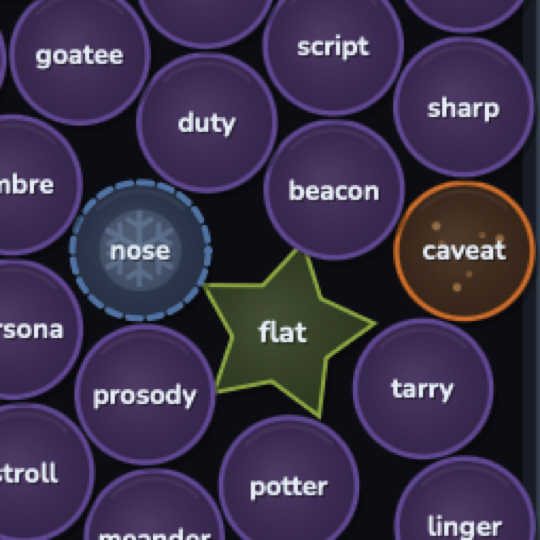
This ball-blast demo, like NYT Connections, asks players to find hidden categories. Unlike Connections, it adds spatial reasoning: words tumble and collide, and grouping them requires physics as well as semantics. Special ball types add a tactical layer on top of the semantic core.
Semantic data lets you match by meaning instead of color or shape: players drag through “jerk,” “tug,” “snatch,” and “wrench” because they recognize these are all ways of pulling. The puzzle shifts from pattern recognition to concept recognition.
Here’s a different mechanic—choose the answer that matches all 4 clues: